Here’s the annoying thing about AI hallucinations: AI can hand you a wrong answer in the exact same calm, polished voice it uses for a right one.
It doesn’t pause. It doesn’t clear its throat. It doesn’t start shuffling papers like a guy who just realized the meeting is about his project. It gives you a name, a date, a policy, and three supporting details with the serene confidence of someone who has definitely checked.
Sometimes it has not.
The lesson here isn’t “never trust AI.” That’s a great way to end up paying for a very expensive autocomplete you’re afraid to use. The lesson is simpler:
Judge the evidence, not the delivery.
The short answer: why AI sounds sure even when it’s wrong
AI chatbots are built to produce language that fits your question. They are extremely good at writing text that sounds natural, complete, and sure of itself.
That is not the same thing as checking each statement against reality.
When an AI produces something plausible but false, researchers call it an AI hallucination. The word makes it sound like the computer wandered into the desert and started seeing palm trees. The reality is more boring and more annoying: a wrong date, a feature that doesn’t exist, a citation for a paper nobody wrote, or one made-up detail tucked into an otherwise useful summary.
The answer sounds confident because fluent language is the product. Accuracy is a separate department, and it doesn’t always get invited to the meeting. That gap is where AI hallucinations live.
What a confident wrong answer looks like
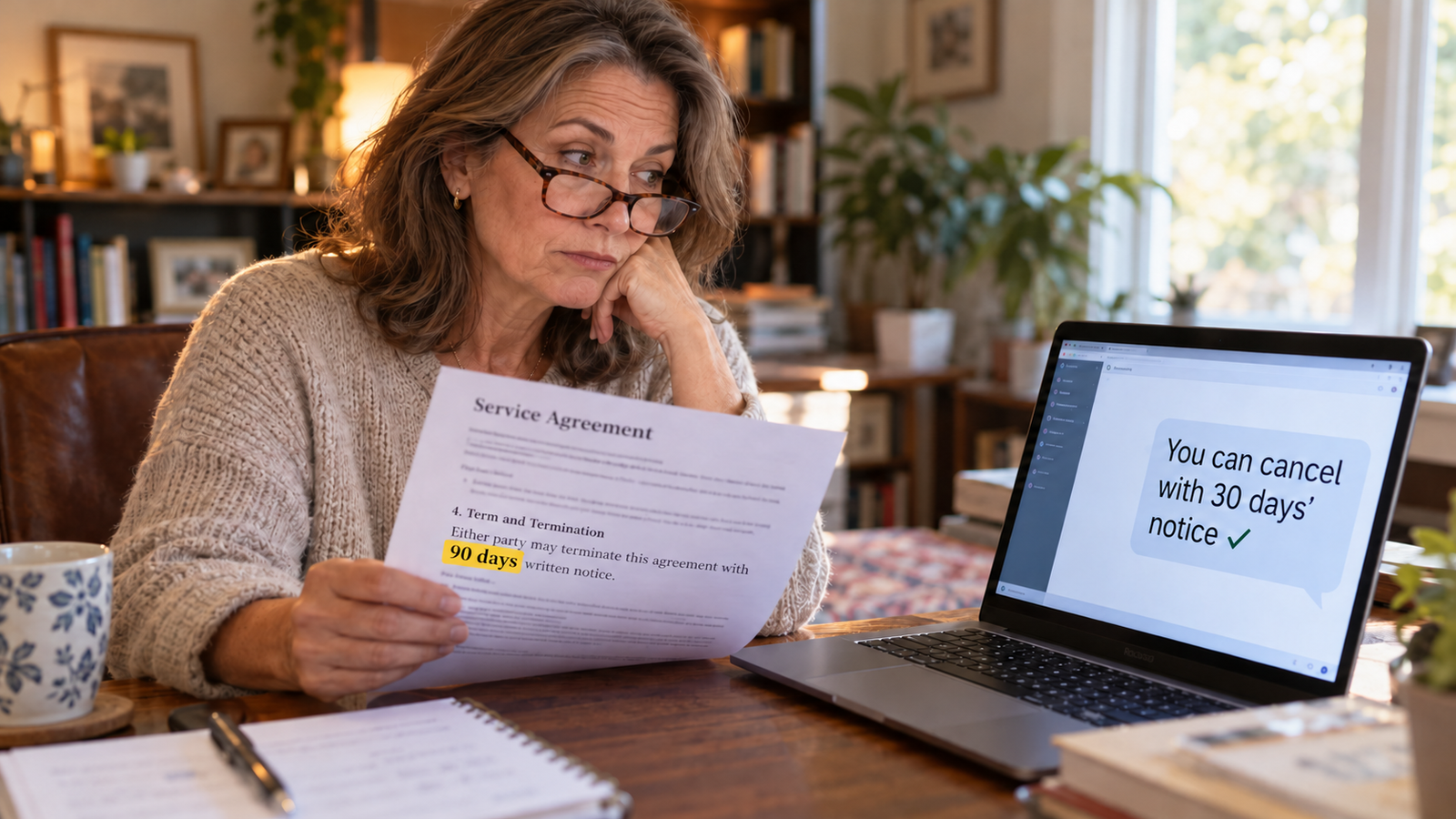
Here’s an illustrative example. You ask an AI tool to summarize a 12-page vendor contract. You get back a clean, organized summary that’s right on nine points out of ten.
Point ten says you can cancel with 30 days’ notice. The contract says 90.
Nothing about the tone changed. No asterisk. No little sweating emoji. The wrong line got the same crisp bullet point as the right ones. That’s the whole problem in one sentence.
Why does AI make things up?
AI language models learn by chewing through enormous amounts of text. In plain terms, they learn to predict which words are likely to come next.
That’s why AI is good at writing a clear email, cleaning up rough notes, explaining an unfamiliar term, or knocking out a decent first draft. It has learned the shape of useful language remarkably well.
But facts don’t behave like grammar.
Common language patterns show up millions of times. A specific person’s birthday, an obscure policy exception, or the exact features in last month’s software update might show up rarely or not at all. When the information is missing, rare, or fuzzy, the AI can still produce an answer that fits the pattern. It fills the blank with something shaped like the truth.
There’s another wrinkle, and it’s a good one. OpenAI researchers, in a 2026 study published in Nature, found that many common AI tests reward right answers but give zero credit for “I don’t know.” Under that kind of scoring, guessing beats honesty. It’s the multiple-choice strategy you learned in eighth grade, now running in a data center the size of a shopping mall.
That doesn’t mean every answer is a reckless guess. It means “give an answer” has been rewarded in parts of how these models get built. The machine learned to be helpful, and somewhere along the way “helpful” got measured as “said something.”
Admitting uncertainty, apparently, needed a better publicist.
Confidence is a style, not a warranty
You might think you can spot a shaky answer by its tone. Hedgy wording. A “might” here and there. A little verbal sweating.
Don’t count on it. A 2026 exploratory study of medical-chatbot answers found that people generally saw the chatbot as confident whether it wrote in a confident style or a cautious one. People also didn’t always catch the inaccurate advice. (It was a small study using hypothetical scenarios, so let’s not carve it into stone. The point still holds.)
You can’t reliably catch AI hallucinations by listening for nervousness.
AI doesn’t give you the human tells. It doesn’t hesitate in the hallway, avoid eye contact, or suddenly develop a deep interest in the carpet. A polished answer can be correct, partly correct, out of date, or completely invented, and all four show up wearing the same nice suit.
Tone doesn’t settle anything.
When to double-check AI answers
You don’t need to launch a federal investigation every time AI fixes a clunky paragraph. You do need to slow down when the answer contains facts that matter. That’s where AI hallucinations do the most damage.
Names, dates, numbers, and quotes
Easy to state precisely. Easy to get wrong. Check them against the original or the official source before you use them anywhere another human might read them.
Summaries of your own documents
If you gave it the document, spot-check the important conclusions against the source. AI can write a perfectly useful summary and quietly slip in an interpretation that was never in the material. Very thoughtful of it.
Software features and how-to steps
Products change. Plans differ. Settings move around because software companies apparently believe in seasonal migration. Check important steps against the current official help pages, especially before you buy something, change who has access, or touch your data.
Policies, rules, and requirements
Company policies, government rules, benefits, contracts, and eligibility requirements are not the place for creative improvisation. Use AI to help you understand the wording. Then check the official source, the one that’s actually in charge.
Citations and sources
Fake citations are one of the classic AI hallucinations. A citation can look perfectly respectable and still not exist. Or it can exist and say something else entirely. Open it. Confirm the title, author, date, and what it actually found.
Health, legal, money, and safety decisions
AI can help you prepare questions or get organized. It should not be the only voice behind a decision where a mistake could hurt someone, cost money, or affect your rights. “The chatbot said so” is not a defense anyone has ever enjoyed using.
The consequence test: 3 questions before you trust an AI answer
- What happens if this is wrong? A bad dinner suggestion is annoying. A wrong dosage, deadline, contract term, or customer promise is a different genre entirely.
- Can I check it easily? If the original document, official policy, or product help page is right there, check the important detail. It takes two minutes. Not checking can take considerably longer.
- Can I undo it? Rewriting a draft is easy. Un-sending private information, un-spending money, and un-publishing a claim are not features that exist.
The more costly, serious, or permanent the action, the less you should lean on an AI answer that hasn’t shown its work.
How to fact-check AI without turning it into homework
Checking AI’s work does not need to eat your afternoon.
Start by making the AI sort its own answer into “supported” and “guessing.” Copy this, fill in the brackets, and paste it right after the answer you’re unsure about:
Look back at your last answer about [topic]. List which parts are directly supported by [the document I gave you / a source you can name], and which parts are assumptions, guesses, or need checking. Be specific. If you aren’t sure about something, say so.
This helps expose the weak spots. It is not proof. You’re asking the student to grade their own test, so adjust your expectations accordingly.
Then check only the few claims your decision actually rides on:
- Compare summaries against the original document.
- Use current official help pages for product features.
- Check policies and rules with whoever issues them.
- Open citations and confirm they exist and say what’s claimed.
- Ask a qualified human when the stakes call for one.
If you can’t verify something important, downgrade it. Treat it as a lead, a question, or a draft. Not a fact.
What AI is still good for
None of this makes AI useless. It just makes it a tool instead of an oracle.
AI is excellent at:
- organizing messy information
- drafting and rewriting
- comparing material you give it
- coming up with questions you missed
- giving you a first-pass explanation
- showing you where you need to dig deeper
Those are real wins. The mistake is letting smooth writing serve as proof of its own accuracy. That’s like hiring a contractor because he has excellent posture.
Use AI for speed. Keep the judgment for yourself.
Frequently asked questions
What is an AI hallucination?
It’s the common term for when an AI states something false as if it were true. It isn’t “seeing things.” It’s filling gaps with text that sounds right. Some researchers prefer the word “confabulation,” which is more accurate and which roughly nobody says out loud.
Does AI know when it’s unsure?
Sometimes. Some AI tools can express uncertainty, and some are built to say “I don’t know.” But the tone of an answer is not a reliable gauge of whether it’s right. A firm tone doesn’t mean it’s certain, and a cautious “might” doesn’t make it safe.
Do I need to fact-check every AI answer?
No. Match the effort to the stakes. A brainstorm list or a reworded sentence just needs a normal read-through. A fact that affects health, money, safety, your rights, your reputation, or another person deserves a real check.
The bottom line
AI sounds certain because sounding clear and convincing is one of the things it does best. That’s exactly why AI hallucinations are so easy to miss.
That voice is not a guarantee. It’s not a source. It’s not evidence. It’s just very good diction.
When the answer matters, check the part that matters.
Judge the evidence, not the delivery.
Keep reading: